Date: (05-02-2027), TIME:
From Quantum Information to Biological Intelligence – ID: , Passcode:
Live on:
Symposium Information
Click Here to Register for the KSAS Symposium 2027!
CONCEPT NOTE
5th Annual KSAS Symposium 2027
International Symposium on Molecular and Sub-Molecular Consciousness
Theme: From Quantum Information to Biological Intelligence
FEBRUARY 5–6, 2027 [Hybrid • In-Person and Virtual (Zoom)]
Venue: Kuruom School of Advanced Sciences (KSAS), Gata No. 960, Utrawan Village, Tehsil Mohanlalganj, Lucknow, Uttar Pradesh 226301 India
Organizers: Kuruom School of Advanced Sciences (KSAS), India, in collaboration with Institute of Advanced Sciences (INADS), USA
At a Glance
CORE QUESTION: How does consciousness arise, and what are its physical, biological, informational, and philosophical foundations?
The 5th Annual KSAS Symposium brings together researchers and scholars to examine consciousness across multiple levels of organization—from quantum and molecular phenomena to cells, neural systems, artificial intelligence, whole organisms, and philosophical perspectives.
Purpose
The symposium is designed as an interdisciplinary forum for rigorous scientific exchange, the exploration of emerging hypotheses, and collaborative discussion concerning the possible relationships among information processing, biological intelligence, cognition, and consciousness.
Priority Disciplines
- Physics and quantum science
- Chemistry, molecular biology and biophysics
- Neuroscience and cognitive science
- Systems biology and cellular intelligence
- Artificial intelligence and computer science
- Mathematics, medicine and engineering
- Philosophy and comparative approaches to consciousness
1.0 Background
Consciousness remains one of the deepest and most enduring questions in science and philosophy. Despite remarkable advances in neuroscience, molecular biology, quantum physics, artificial intelligence, cognitive science, information theory, and related disciplines, a comprehensive understanding of the origins, mechanisms, and physical basis of consciousness has yet to emerge.
Contemporary neuroscience has traditionally approached consciousness primarily through neuronal activity, brain networks, information integration, and cognitive processes. At the same time, emerging research in quantum biology, molecular biophysics, systems biology, cellular signaling, information theory, and artificial intelligence is raising important questions about whether information processing and adaptive intelligence may operate across multiple levels of biological organization.
Proteins undergo dynamic conformational changes that enable them to store, transmit, and respond to information. Cells continuously sense and integrate environmental signals through complex molecular and biochemical networks. Biological systems demonstrate remarkable capabilities for self-organization, adaptation, decision-making, learning, and memory. These observations invite deeper investigation into the relationship between molecular information processing, biological intelligence, cognition, and consciousness.
Developments in quantum science have further stimulated discussion concerning the possible roles of coherence, superposition, tunneling, entanglement, information, and non-separability in biological systems. While many proposed connections between quantum phenomena and consciousness remain theoretical or controversial, they provide important interdisciplinary questions that can be examined through rigorous scientific, computational, experimental, and philosophical approaches.
At the same time, classical philosophical traditions have explored consciousness as a fundamental aspect of reality for centuries. These perspectives provide a valuable intellectual framework for examining questions concerning mind, matter, perception, cognition, selfhood, and the nature of reality.
The convergence of these developments creates an opportunity for dialogue among scientists, philosophers, engineers, clinicians, and researchers working at different levels of biological and physical organization.
Recognizing the need for such interdisciplinary dialogue, KSAS, in collaboration with INADS, proposes the 5th Annual KSAS Symposium: International Symposium on Molecular and Sub-Molecular Consciousness. The symposium will bring together researchers from diverse disciplines to examine consciousness from molecular, sub-molecular, cellular, neural, organismal, computational, informational, and philosophical perspectives.
2.0 Symposium Theme
The central theme is the exploration of how information is generated, processed, stored, transmitted, and integrated within physical and biological systems, and how such processes may contribute to intelligence, cognition, and consciousness.
The symposium will examine these questions across multiple levels—from quantum and molecular phenomena to cells, neural systems, artificial intelligence, whole organisms, and broader philosophical interpretations of consciousness.
3.0 Vision and Objectives
Vision
To advance Molecular and Sub-Molecular Consciousness as an interdisciplinary area of scientific inquiry by bringing together molecular biology, neuroscience, quantum science, artificial intelligence, systems biology, information theory, physics, chemistry, mathematics, medicine, cognitive science, and philosophy.
The symposium seeks to establish a collaborative platform for researchers to examine the possible physical and biological foundations of consciousness and to develop scientifically testable questions about information processing, intelligence, cognition, and awareness across different scales of organization.
Objectives
1. Examine molecular, sub-molecular, cellular, neural, and quantum perspectives on consciousness.
2. Explore whether biological molecules and cellular systems process and integrate information in ways that may be relevant to cognition and intelligence.
3. Examine quantum phenomena in biological systems and their possible relevance to information processing and consciousness.
4. Investigate consciousness and intelligence across multiple biological scales, from molecules and cells to neural networks and whole organisms.
5. Explore relationships between biological intelligence and artificial intelligence.
6. Examine emerging scientific approaches to molecular memory, cellular communication, self-organization, adaptation, and decision-making.
7. Foster dialogue between contemporary scientific research and classical and practical philosophical traditions concerning consciousness.
8. Encourage interdisciplinary collaboration among researchers from physics, chemistry, biology, neuroscience, medicine, computer science, artificial intelligence, mathematics, cognitive science, and philosophy.
9. Identify significant unanswered questions and promising directions for future research.
10. Provide a forum for original findings, emerging concepts, innovative methodologies, and interdisciplinary perspectives.
4.0 Scientific Themes
Quantum Foundations of Consciousness
- Quantum coherence and superposition
- Quantum information and tunneling
- Entanglement and non-separability
- Emergence and complexity
- Quantum biology
- Quantum thermodynamics
Molecular Information Processing
- Protein dynamics
- Protein conformational landscapes
- Molecular signaling
- Biomolecular computation
- Molecular information storage and transmission
- Molecular memory
Cellular Intelligence and Consciousness
- Cell-cell communication
- Cellular information processing
- Cellular decision-making
- Immune cognition
- Stem-cell decision-making
- Self-organization and adaptation
Neuroscience of Consciousness
- Neural circuits and networks
- Brain connectivity and connectomics
- Brain oscillations
- Memory and cognition
- Neural information processing
- Microtubules and consciousness
- Disorders of consciousness
Cellular Intelligence and Artificial Intelligence
- Biological versus artificial intelligence
- Machine consciousness
- AI cognition
- Cellular intelligence
- Information processing in biological systems
- Computational models of biological intelligence
Philosophy and Consciousness
- Buddhist philosophy and consciousness
- Yoga and consciousness
- Mind-body problem
- Consciousness and the nature of reality
- Comparative philosophical perspectives
- Integrated philosophical approaches
- Consciousness beyond strictly materialist interpretations
- Dialogue between philosophy and contemporary science
5.0 Proposed Program
(see "Program Details" section below)
6.0 Expected Outcomes
- Establish a sustained interdisciplinary dialogue on molecular and sub-molecular consciousness.
- Identify major scientific questions and research priorities.
- Promote collaboration across physics, chemistry, biology, neuroscience, AI, mathematics, medicine, cognitive science, and philosophy.
- Encourage new interdisciplinary research programs and collaborations.
- Facilitate discussion of emerging hypotheses and scientifically testable approaches to consciousness.
- Provide opportunities for researchers and early-career scientists to present their work.
- Strengthen international academic and scientific networks.
- Document significant presentations and discussions through symposium proceedings.
- Contribute to the development of Molecular and Sub-Molecular Consciousness as an emerging interdisciplinary field.
7.0 Target Participants
The symposium is intended for researchers, scholars, professionals, students, and other participants working in or interested in interdisciplinary approaches to consciousness.
8.0 Expectations from Interested Speakers
Researchers interested in delivering an invited or contributed presentation are encouraged to submit a presentation title, a brief abstract of approximately 250–300 words, and a short biography highlighting relevant expertise and contributions.
Presentations should emphasize original research, emerging concepts, innovative methodologies, theoretical developments, or interdisciplinary perspectives that contribute to the understanding of molecular and sub-molecular consciousness.
Speakers are encouraged to present scientifically rigorous work while making their presentations accessible to participants from diverse academic backgrounds. Contributions that promote interdisciplinary dialogue, challenge established assumptions through scientifically grounded inquiry, or propose novel research directions are particularly welcome.
9.0 Symposium Proceedings
Invited and contributed speakers will be invited to submit manuscripts for possible inclusion in the official Symposium Proceedings. Authors will be requested to submit a short manuscript of approximately 2,000–3,000 words based on their presentation. Please send abstracts and manuscripts to Dr. Raj Kumar at rkumar@inads.org.
The proceedings will serve as a lasting scientific record of the symposium, capturing current knowledge, emerging hypotheses, interdisciplinary perspectives, and future directions in this developing field. They will be published as the official Proceedings of the International Symposium on Molecular and Sub-Molecular Consciousness and made available on Amazon in Kindle and paperback formats. Please visit ksas.inads.org; the link will be added once published.
The 4th Annual KSAS Symposium 2026 Cognition Across Life: From Cells to Consciousness official Symposium Proceedings is available now on Amazon in Kindle and paperback formats at https://www.amazon.com/dp/B0H4WXJWB1.
Manuscript Structure
- Title
- Author(s) and Affiliations
- Abstract: 150–250 words
- Keywords: 4–6 keywords
- Introduction
- Main Text / Presentation-Based Discussion
- Conclusions
- Acknowledgements: Optional
Formatting Requirements
- Times New Roman, 12 pt
- 1.5 line spacing
- 1-inch (2.54 cm) margins
- A4 page size
- Justified text
10.0 Organizing Institution and Collaborators
The 5th Annual KSAS Symposium will be hosted by the Kuruom School of Advanced Sciences Foundation (KSAS), India.
It is in collaboration with the Institute of Advanced Sciences (INADS), Dartmouth, Massachusetts, USA.
The symposium welcomes sponsorship and institutional support from academic institutions, private foundations, research organizations, and industry. Please contact Dr. Raj Kumar rkumar@inads.org or Dr. Bal Ram Singh bsingh@inads.org for more information.
Book publishers, scientific organizations, technology companies, and relevant exhibitors are invited to participate by displaying appropriate publications, technologies, and research-related materials and by engaging with symposium participants.
11.0 Conclusion
The 5th Annual KSAS Symposium: International Symposium on Molecular and Sub-Molecular Consciousness seeks to create a scientifically rigorous and intellectually open forum for examining one of the most fundamental questions confronting modern science: How does consciousness arise, and what are its physical, biological, informational, and philosophical foundations?
By bringing together researchers across molecular biology, quantum science, neuroscience, artificial intelligence, systems biology, information theory, medicine, mathematics, and philosophy, the symposium will encourage dialogue across traditional disciplinary boundaries.
The symposium will provide an opportunity to examine established knowledge, emerging hypotheses, controversial questions, and promising research directions while fostering new collaborations among scientists and scholars from around the world.
Through scientific presentations, interdisciplinary discussions, philosophical perspectives, and collaborative exchange, the 5th Annual KSAS Symposium seeks to contribute to a broader and deeper scientific framework for understanding consciousness.
Program Details
Day 1 — Friday, February 5, 2027
2:00 PM – 8:00 PM
- Registration and Welcome Address
- Inauguration Ceremony and Saraswati Vandana
- Inaugural Keynote Lecture – What is Consciousness? Challenges and Opportunities in Modern Science
- Distinguished Lecture I – Quantum Reality and Biological Information
- Distinguished Lecture II – Molecular Basis of Intelligence and Cognition
- Panel & Audience Interaction/Questions – Is Consciousness Fundamental or an Emergent Property of Matter?
- Anticipated Panelists: Physicist, Molecular Biologist, Neuroscientist, AI Researcher, and Philosopher
8:00 PM
- Dinner
Day 2 — Saturday, February 6, 2027
9:00 AM – 8:00 PM
- Session I — Cultural Program and Play(s)
- Session II — Quantum Science and Consciousness
- Three invited talks followed by discussion: Quantum Coherence/Superposition, Quantum Information/Tunnelling, Non-Separability/Emergence, Quantum Biology, Quantum Thermodynamics
- Morning Break
- Session III — Molecular and Cellular Consciousness
- Three invited talks followed by discussion: Protein Dynamics, Molecular Signaling, Cellular Information Processing, Systems Biology
- Lunch
- Session IV — Neuroscience of Consciousness
- Three invited talks followed by discussion: Neural Networks, Brain Connectivity, Memory, Cognitive Processes
- Afternoon Break
- Session V — Cellular Intelligence and Artificial Intelligence
- Three invited talks followed by discussion: Machine Consciousness, AI Cognition, Cell Communication, Stem Cell Decision Making, Self-Organization
- Session VI — Philosophy Meets Science
- Invited lectures on Comparative Philosophy and Consciousness Beyond Materialism
- Evening Break
- Panel — Building the Future of Molecular and Sub-Molecular Consciousness Research
- Discussion: Grand Scientific Challenges Related to Consciousness Research
- Vote of Thanks and Closing Remarks
8:00 PM
- Dinner
Kuruom School of Advanced Sciences, Lucknow, India & Institute of Advanced Sciences (INADS), Dartmouth, MA, USA
Date: (06-02-2026), TIME: 4 PM (IST)
Annual Symposium on Cognitive Biology – ID: , Passcode:
130612
Live on: Zoom
Symposium Information
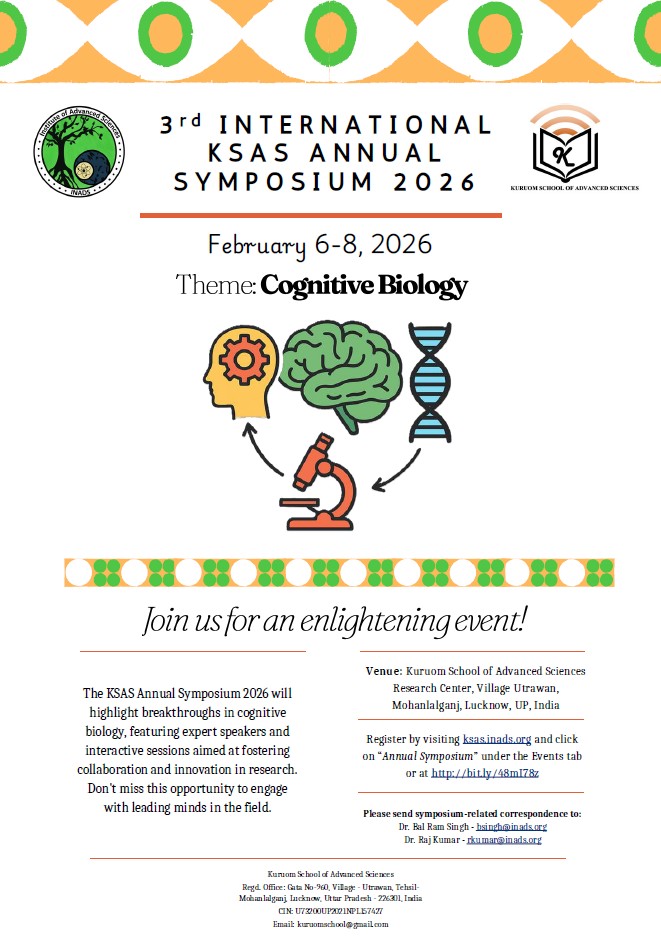
The 2026 KSAS Annual Symposium will be held on February 6 to 8, 2026.
Purchase the KSAS Symposium 2026 Official Proceedings Here!
Theme: Cognition Across Life: From Cells to Consciousness
The symposium will highlight breakthroughs in cognitive biology, featuring expert speakers and interactive sessions aimed at fostering collaboration and innovation in research. Don't miss this opportunity to engage with leading minds in the field.
Zoom Meeting for Friday, February 6, 2026: Meeting ID: 886 8432 7227 <-- click link to attend
Zoom Meeting for Saturday, February 7, 2026: Meeting ID: 896 0636 7016 <-- click link to attend
Zoom Meeting for Sunday, February 8, 2026: Meeting ID: 834 9503 5133 <-- click link to attend
Program Details
Anticipated Presenters & Participants
- Suhas Kshirsagar - BAMS, MD, Ayurveda, Director of Healing, Santa Cruz, CA, USA
- Subhash Kak - Regents Professor, Oklahoma State University, Stillwater, OK, USA
- Chander Kanwar Bhardwaj - Life Member, World Association of Vedic Studies, Atlanta, GA, USA
- Jerry Solfvin - Professor, University of MA-Dartmouth, MA, USA
- Varsha Singh - Professor, IIT, Delhi, India
- Tanushri Kaul - Group Leader, ICGEB, Delhi, India
- Santala Hegde - NIMHANS, Bangalore, India
- Alex Hankey - Theoretical Physicist, Professor, MIT, Pune, India
- John Bogdan, Jr. - President & CEO, Valeria Technical Consultants, LLC & CYGNOS Biotech LLC, USA
- Darshan Mehta - MD, Harvard Medical School, Boston, MA, USA
- Peter M. Wayne - Associate Professor, Harvard Medical School, Boston, MA, USA
- Sangeetha Menon - Professor, ICGEB, Delhi, India
- Vishwanathan Ramesh - Professor, University of Frankfurt, Germany
- Chandra Sekhar Mayanil - Retired Scientist, Lurie Children's Hospital, Chicago, IL, USA
- Mrittunjoy Guha Majumdar - Assistant Professor, Amrita Vishwavidyapeetham, Delhi, India
- Bal Ram Singh - President, INADS, Dartmouth, MA, USA
- Raj Kumar - Associate Professor, INADS, Dartmouth, MA, USA
- K. Gopinath Pillai - Institute of Advanced Study, Shimla, India
- Valeri Barsegov - University of MA-Lowell, MA, USA
Program Schedule
Day 1: Friday, February 6, 2026
4 pm (IST)
- Social
5:30 pm - 6:30 pm (IST)
- Performance by the students of Kuruom Vidyalaya on cognition and life
- Welcome dance
- Guitar performance by Dr. John Bogdan, Jr.
- "Voice of Mind"
- "Operation Sindoor"
6:30 pm - 7:30 pm (IST)
- Symposium speech - chaired by Dr. Alex Hankey, Theoretical Physicist, Professor of Philosophy of Science,
Maharashtra Institute of Technology, Pune, India- Topic: "Framing the Vision of Cognitive Biology" by Dr. Suhas Kshirsagar, Advisor, National Ayurvedic Medical Association
7:30 pm (IST)
- Dinner
Day 2: Saturday, February 7, 2026
9 am - 10 am (IST)
- Registration open, social, and breakfast
10 am - 10:45 am (IST)
- Saraswati Vandana, followed by a formal welcome and presentation by Dr. Raj Kumar, KSAS, India
Session I
10:45 am - 11 am (IST)
- Speech by Vishist Athiti, Mr. Raja Ram
11 am - 12 pm (IST)
- Keynote speech - chaired by Dr. John Bogdan, Jr., President and CEO, Valaria Technical Consultants, LLC, MD, USA
- Topic: "Cognition Beyond Brains: Redefining Intelligence in Nature" by Dr. Shiv Satchit, Journalist and Media Technology Consultant
12 pm - 12:15 pm (IST)
- Break
Session II - Minimal Cognition: Insight from Unicellular Organisms and Plants (chaired by Dr. Ashutosh Pareek, Educator and Author, India)
12:15 pm - 12:45 pm (IST)
- Presentation I
- Topic: "Cognition of Medhya Rasayana" by Dr. Yamini Bhushan Tripathi, Banaras Hindu University, India
12:45 pm - 1:15 pm (IST)
- Presentation II
- Topic: "Achar Rasayan: The Psychosomatic Link Between Behavioral Ethics and Biological Longevity" by Mr. Harsh Pande, Student, Jawaharlal Nehru University, Delhi, India
1:15 pm - 1:45 pm (IST)
- Presentation III
- Topic: "Role of Atomic, Molecular, and Genetic Factors in Evolutionary Conscious Connection of Microorganisms and Plants" by Dr. Bal Ram Singh, President, INADS, MA, USA
1:45 pm - 2:45 pm (IST)
- Lunch
Session III - The Origins of Cognition: Evolutionary and Developmental Perspective (chaired by Dr. Shiv Satchit, Journalist and Media Technology Consultant)
2:45 pm - 3:15 pm (IST)
- Presentation I
- Topic: "Cosmic Cognitive Restructuring To Go Beyond Cognition" by Dr. Chander Kanwar Bhardwaj, Life Member, World Association of Vedic Studies, GA, USA
3:15 pm - 3:45 pm (IST)
- Presentation II
- Topic: "Arsa Theories of Cognition: Scriptural Foundations and Developmental Perspectives" by Dr. Ashutosh Pareek, Educator and Author, India
3:45 pm - 4:15 pm (IST)
- Presentation III
- Topic: "Physical Research, Parapsychology, and Cognitive Biology" by Dr. Jerry Solfvin, University of Massachusetts - Dartmouth, MA, USA
4:15 pm - 4:45 pm (IST)
- Break
Session IV
4:45 pm - 5:30 pm (IST)
- Panel Discussion - chaired by Dr. Alex Hankey, Theoretical Physicist, Professor of Philosophy of Science, Maharashtra Institute of Technology, Pune, India
- Topic: "Where Does Cognition Begin? Philosophical and Biological Views" by panelists Dr. Shiv Satchit, Dr. Chander Kanwar Bhardwaj, and Dr. Mrityunjay Guha Majumdar
5:30 pm - 6:00 pm (IST)
- Poster Session
6:30 pm (IST)
- Dinner
Day 3: Sunday, February 8, 2026
8 am - 9 am (IST)
- Breakfast and social
Session V
9 am - 10 am (IST)
- Keynote speech - chaired by Dr. Bal Ram Singh, President, INADS, MA, USA
- Topic: "Delaying Cognitive Decline: Disease-Modifying Therapy and the Evolving Role of Rehabilitation" by Dr. Nirmal Surya, Chairman, Surya Neuro Center & Fellow American Academy of Neurology
10 am - 10:15 am (IST)
- Break
Session VI - Cellular and Molecular Bases of Cognition (chaired by Dr. Gajendra Pratap Singh, Professor, Jawaharlal Nehru University, Delhi, India)
10:15 am - 10:45 am (IST)
- Presentation I
- Topic: "Cellular Cognition in Neuro-Immune Systems" by Dr. Chandra Sekhar Mayanil, Retired Principal Scientist, Lurie Children's Hospital, IL, USA
10:45 am - 11:15 am (IST)
- Presentation II
- Topic: "Information Encoded by the Subjective Self During Cognition: Its Overall Structure as a Banach Space" by Dr. Alex Hankey, Theoretical Physicist, Professor of Philosophy of Science, Maharashtra Institute of Technology, Pune, India
11:15 am - 11:45 am (IST)
- Presentation III
- Topic: "Cellular and Molecular Toxins: Friends or Foes?" by Dr. John Bogdan, Jr., President and CEO, Valaria Technical Consultants, LLC, MD, USA
11:45 am - 12:15 pm (IST)
- Presentation IV
- Topic: "Molecular Target-Based Development of Drug-Like and Fluorescent Molecules for Alzheimer's Disease" by Dr. Abha Sharma, National Institute of Pharmaceutical Education and Research, Raebareli, India
12:15 pm - 1:15 pm (IST)
- Lunch
Session VII - Synthetic and Artificial Systems: Bio-Inspired Cognitive Architectures (chaired by Dr. Chander Kanwar Bhardwaj, Life Member, World Association of Vedic Studies, GA, USA)
1:15 pm - 1:45 pm (IST)
- Presentation I
- Topic: "Mathematical Network Models of Cognition in Biological Systems" by Dr. Gajendra Pratap Singh, Professor, Jawaharlal Nehru University, Delhi, India
1:45 pm - 2:15 pm (IST)
- Presentation II
- Topic: "Quantum General Artificial Intelligence" by Dr. Mrityunjay Guha Majumdar, Assistant Professor, Amrita Vishwaidyapeetham, Delhi, India
2:15 pm - 2:45 pm (IST)
- Presentation III
- Topic: "A Transdisciplinary Systems Perspective on Intelligence" by Dr. Vishwanath Ramesh, Professor, University of Frankfurt, Germany
2:45 pm - 3:15 pm (IST)
- Presentation IV
- Topic: "Computational Modeling of Biological Systems: Application to Cognition at the Cellular and Whole System Level" by Dr. Valeri Barsegov, University of Massachusetts - Lowell, MA, USA
3:15 pm - 3:30 pm (IST)
- Break
Session VII - Environmental Influences on Cognitive Processes (chaired by Dr. Shiv Satchit, Journalist and Media Technology Consultant)
3:30 pm - 4 pm (IST)
- Presentation I
- Topic: "Cosmic Intelligence and the Evolution of Cognition" by Dr. Gopinath Pillai, Indian Institute of Advanced Study, Simla, India
4 pm - 4:30 pm (IST)
- Presentation II
- Topic: "Mitochondria Under Pressure: Exploring the Stress-Mind-Body Connection in Health and Disease" by Dr. Darshan Mehta, Harvard Medical School, Boston, MA, USA
4:30 pm - 5 pm (IST)
- Presentation III
- Topic: "Minding the Body: Tai Chi for Cognitive-Motor Health in Older Adults" by Dr. Peter Wayne, Osher Center, Harvard Medical School, Boston, MA, USA
5 pm - 5:30 pm (IST)
- Break
Session VIII
5:30 pm - 6:15 pm (IST)
- Panel discussion - chaired by Dr. Bal Ram Singh, President, INADS, MA, USA
- Topic: "Designing a Research Agenda for Cognitive Biology" with panelists Dr. John Bogdan, Jr., Dr. Gopinath Pillai, and Dr. Ashutosh Pareek
6:15 pm - 6:30 pm (IST)
- Vote of thanks and symposium conclusion
6:30 pm (IST)
- Dinner
Poster Sessions
- "Introduction to Cognitive Biology" presented by Aparna, Karthika, and Aradhana of Kuruom School, Sultanpur
- "The Brain Computer Interface" presented by Rishab Pandey and Anmol Singh of Kuruom School, Sultanpur
- "Sleep and Cognition" presented by Abhinav Mishra, Ayush, and Shreyansh Singh of Kuruom School, Sultanpur
- "The Biology of Emotions" presented by Ishan Shekhar and Mudit of Kuruom School, Sultanpur
- "The Neural Mechanism of Cognition" presented by Ayushi, Chanchal, and Kalyani of Kuruom School, Sultanpur
- "Philosophical Foundations of Economy: Revisiting Arth in Indian Thought" presented by Alok Kumar Dwivedi of KSAS, Lucknow
- "Sangyanatmak Jiv-Vigyan Mein Vaidik Vak: Sristi Ke Karan Rupa" presented by Aparna Dhir of INADS, USA
- "Development of Monoclonal and Bispecific Antibodies Against Cytokine-Generated Inflammations" presented by Avinash Tiwari of KSAS, Lucknow
- "Development of Engineered T-Cells for Therapeutics" presented by Abhinandan Mani Tripathi of KSAS, Lucknow
- "Research Programs at KSAS" presented by Manish Singh Kaushik of KSAS, Lucknow
Kuruom School of Advanced Sciences, Lucknow, India & Institute of Advanced Sciences (INADS), Dartmouth, MA, USA
Meeting link: https://us02web.zoom.us/j/6977021728?pwd=NlZWQ1p5d3BXQTdKWDhHUC95L3UxZz09&omn=85709155583
Date: (07-02-2025), TIME: 4 PM (IST)
Annual Symposium on Consciousness Through Sciences and Philosophy – ID: 697 702 1728, Passcode:
130612
Live on: YouTube : @KSASTALK
Symposium Information
An International Symposium on Consciousness Through Science and Philosophy was held on February 7-9, 2025.
Venue: KSAS, Narayan Kheda, Near Madapur Mandir, Mohanlalganj, Lucknow, India - 226302
Symposium Coordinators:
- Dr. Bal Ram Singh (bsingh@inads.org)
- Dr. Raj Kumar (rkumar@inads.org)
- Dr. Shipra Dikshit (sdikshit@inads.org)
- Dr. Alok Dwivedi (adwivedi@inads.org)
- Dr. Abhinandan Mani Tripathi (atripathi@inads.org)
- Dr. Shruchi Singh (ssingh@inads.org)
Program Details
Program Schedule (Indian Standard Time - IST)
February 7, 2025
4:00 pm
- Social
5:30 pm - 6:15 pm
- A play by the students of Kuruom Vidyalaya, Sultanpur, reflecting the vision and values of KSAS
- Shiv Tandav by Ms. Anshika Singh of Kuruom Vidyalaya, Sultanpur
6:15 pm - 7:15 pm
- Chaired by Dr. Bal Ram Singh, President, INADS, Dartmouth, MA, USA
- Symposium Speech
- Dr. Subhas Kak, Regents Professor at Oklahoma State University and a member of the Indian Prime Minister's Science, Technology, and Innovation Advisory Council
- Topic: "New Scientific Results on the Nature of Consciousness"
7:15 pm - 7:45 pm
- A special presentation by Dr. John Hagelin, world-renowned particle physicist and international president of the Global Union of Scientists for Peace
- Topic: "Dark Matter, Subtle Bodies, and Rebirth"
8:00 pm
- Dinner
February 8, 2025
9:00 am - 10:00 am
- Registration, social, and breakfast
10:00 am - 10:45 am
- Saraswati Vandana followed by "Welcome Speech" and presentation by Dr. Raj Kumar, KSAS, India
Session I
10:45 am - 11:45 am
- Chaired by Dr. David Schraf, Professor and Chair of the Physics Department, Maharshi University, USA
- Speech by Vishist Athiti
- Keynote speech by Dr. Alex Hankey, well-known Theoretical Physicist, Professor of Philosophy of Science
- Topic: "The Physical Origins of the Self-Referral Nature of Consciousness and Some Consequences"
11:45 am - 12:00 pm
- Break
Session II - Plant and Animal Consciousness
12:00 pm - 12:30 pm
- Chaired by Dr. R.S. Kaushal, Former UGC Research Professor, Department of Physics and Astrophysics, University of Delhi, India
- Presentation I - Dr. Neeti Sanan Mishra, Professor and Group Leader, ICGEB, India
- Topic: "Plant Consciousness: Exploring Mechanisms of Priming and Stress Memory"
12:30 pm - 1:00 pm
- Presentation II - Dr. Nishkam Shanta, Sevaite President Acharya, Sri Chaitanya Saraswat Math, West Bengal, India
- Topic: "A Comparative Analysis of Consciousness in Humans, Animals, Plants, and Unicellular Organisms"
1:00 pm - 1:30 pm
- Presentation III - Dr. Bal Ram Singh, President, INADS, USA
- Topic: "Connections of Animals' Consciousness with Evolutionary Advantage in Nature"
1:30 pm - 2:00 pm
- Presentation IV - Dr. Baishnab Tripathi, Distinguished Professor, Biotechnology, Sharda University, NOIDA, India
- Topic: "Plant Consciousness: A Perspective"
2:00 pm - 2:45 pm
- Lunch
Session III - Can Consciousness Be Quantized?
2:45 pm - 3:15 pm
- Chaired by Dr. Manogna Sastry, Infinity Foundation, India
- Presentation I - Dr. David Scharf, Professor and Chair of the Physics Department, Maharshi University, USA
- Topic: "Consciousness and Quantum Field Theory: Bridging Science, Philosophy, and Vedic Perspectives"
3:15 pm - 3:45 pm
- Presentation II - Dr. Vinod Deshmukh, Neurology
- Topic: "Turiya-Like Conscious State: A Personal Experience"
3:45 pm - 4:15 pm
- Presentation III - Dr. Mrityunjay Guha Majumdar, Adjunct Faculty, School of Natural Science and Engineering, National Institute of Advanced Studies, Bangalore, India
- Topic: "Is There a Quantum Path Cit Beyond Neuroscience?"
4:15 pm - 4:45 pm
- Presentation IV - Dr. Swasti Tiwari, Professor and Head of Department, Molecular Medicine and Biotechnology, SGPGI, Lucknow, India
- Topic: "Consciousness: A Determinant of Scientific Research Outcomes"
4:45 pm - 5:00 pm
- Break
Session IV - Panel Discussion
5:00 pm - 6:00 pm
- Chaired by Dr. Alex Hankey
- Panelists include Dr. David Schraf, Dr. Neeti Sanan Mishra, Dr. Sampadanand Mishra, and Dr. R.S. Kaushal
- Topic: "Reality or Perception: How to Define Things Around Us"
6:15 pm - 6:45 pm
- Drama performed by the students of Kuruom Vidyalaya, Sultanpur
- Folk song performed by Mr. Harsh Pandey, a student at JNU, India
7:00 pm
- Dinner
February 9, 2025
8:00 am - 9:00 am
- Breakfast and social
Session V
9:00 am - 10:00 am
- Chaired by Dr. Sampadanand Mishra, Director at the Center of Human Science, Rishihood University, India
- Keynote speech by Dr. Manogna Sastry, Infinity Foundation, India
- Topic: "Selfhood and Consciousness in the Age of AI"
10:00 am - 10:15 am
- Break
Session VI - Science of Consciousness
10:15 am - 10:45 am
- Chaired by Dr. Nishkam Shanta, Sevaite President Acharya, Sri Chaitanya Saraswat Math, West Bengal, India, and Dr. Neeti Sanan Mishra, Professor and Group Leader, ICGEB, India
- Presentation I - Dr. Raju Chidambram, Expert in Satellite Communication
- Topic: "Vedanta Answer to Chalmers' Hard Problem of Consciousness
10:45 am - 11:15 am
- Presentation II - Dr. Sukalyan Sengupta, Professor, UMass Dartmouth, USA
- Topic: "Pure Consciousness, Borrowed Consciousness, and Artificial Consciousness: The Vedantic Framework"
11:15 am - 11:45 am
- Presentation III - Dr. Fred Travis, Director at Brain Center, Maharshi University, USA
- Topic: "Consciousness Through the Lens of Modern Science and Maharishi Vedic Science: The Map and the Territory"
11:45 am - 12:15 pm
- Presentation IV - Dr. Vijana Muni, President, Sri Chaitanya Saraswat Institute, West Bengal, India
- Topic: "Understanding the Stepwise Development of Human Consciousness from Vedanta"
12:15 pm - 12:45 pm
- Presentation V - Dr. Sushil K. Jha, Associate Professor of Neuroscience, JNU, India
- Topic: "The Conscious Mind of Rodents: Behavioral and Neural Perspectives"
12:45 pm - 1:30 pm
- Lunch
Session VII - The Philosophical Concept of Consciousness
1:30 pm - 2:00 pm
- Chaired by DR. Nishkam Shanta, Sevaite President Acharya, Sri Chaitanya Saraswat Math, West Bengal, India
- Presentation I - Dr. R.S. Kaushal, Former UGC Research Professor, Department of Physics and Astrophysics, University of Delhi, India
- Topic: "From Atom to Atma: Exploring a Model of Human Consciousness"
2:00 pm - 2:30 pm
- Presentation II - Dr. Sampadanand Mishra, Director at the Center of Human Science, Rishihood University, India
- Topic: "The Four-Fold of Consciousness: Insight from Aitareya Upanishad"
2:30 pm - 3:00 pm
- Presentation III - Dr. R.P. Singh, Dean, Faculty of Humanities and Religious Studies, Guru Nanak Dev University, India
- Topic: "Philosophical Perspectives of Consciousness"
3:00 pm - 3:30 pm
- Presentation IV - Dr. K. Gopinath Pillai, Fellow, Indian Institute of Advanced Study, Shimla, India
- Topic: "Consciousness: An Experience Reality - Approached Through Santhigiri Text"
3:30 pm - 4:00 pm
- Presentation V - Dr. J.S. Rajpurohit, National Convenor at UGC-Net and Consultant, Ministry of Education, Government of India
- Topic: "Unconsciously Conscious Matrix of Happiness"
4:00 pm - 4:30 pm
- Break
Session VIII - Panel Discussion
- Chaired by Dr. R.P. Singh
- Panelists include Dr. R.S. Kaushal, Dr. Fred Travis, Dr. Amit Kumar, and Dr. Manogna Sastry
5:30 pm - 5:40 pm
- Vote of thanks and conclusion
6:00 pm
- Conclusion, dinner, and evening snacks
Kuruom School of Advanced Sciences, Lucknow, India & Institute of Advanced Sciences (INADS), Dartmouth, MA, USA
Meeting link: https://us02web.zoom.us/j/83954252002?pwd=Y2ZRYWJJMGpoSjRKOE5pVHZ1cTVmUT09
Date: (02-02-2024), TIME: 2:30 pm (IST)
International Symposium on Philosophy and Science as a New Educational Paradigm – ID: 839 5425 2002, Passcode:
212193
Live on: YouTube : @KSASTALK
Symposium Information
Venue: Kuruom School of Advanced Sciences (KSAS), Village Uttrawan, Mohanlalganj, Lucknow, Uttar Pradesh - 226302
2024 KSAS Annual Symposium Coordinators:
- Dr. Bal Ram Singh (bsingh@inads.org)
- Dr. Raj Kumar (rkumar@inads.org)
- Dr. Shipra Dikshit (sdikshit@inads.org)
- Dr. Alok Dwivedi (adwivedi@inads.org)
*For information on future symposiums and events, please visit www.KSAS.inads.org
Program Details
Program Schedule (February 2-4, 2024)
February 2, 2024
2:30 pm - 3:30 pm
- Registration, Evening Snacks, & Socialization
3:30 pm - 3:45 pm
- Welcome Speech and Introduction to Symposium
3:45 pm - 4:15 pm
- Dr. Rama Shanker Verma, MNNIT, India
- Topic: "How to Apply Knowledge to Build the Nation"
4:15 pm - 4:45 pm
- Dr. Maheep, Principal Investigator, IGNOU, India
- Topic: "Philosophical Foundation of India's Foreign Policy: Contextualizing Spiritual and Intellectual Traditions"
4:45 pm - 5:45 pm
- Professor David Scharf, Department of Physics, Maharishi University, Iowa, USA
- Topic: "Physics and Consciousness"
Session I - Exploring Consciousness
5:45 pm - 6:15 pm
- Presentation I - Dr. Pawan Dhar, School of Life Sciences, Jawaharlal Nehru University, Delhi, India
- Topic: Exploring the Nature of Consciousness"
6:15 pm - 6:45 pm
- Presentation II - Dr. Frederick Travis, Maharishi University, Iowa, USA
- Topic: "Patterns of Motivational Approach and Coherence in Life in a Meditating Population with a Range of Transcendental Experiences"
6:45 pm - 7:15 pm
- Meditation Session & Presentation by Mrs. Aparna Sharma
- Topic: "Unveiling Consciousness in the Bhagavad Gita"
7:30 pm - 8:30 pm
- Dinner
February 3, 2024
8:00 am - 9:00 am
- Registration, Breakfast, and Socialization
9:00 am - 9:20 am
- Welcome Speech and Saraswati Vandana
9:20 am - 10:10 am
- Speech by distinguished guest, Mr. Shivdas Atri, followed by keynote speaker, Dr. Sudhir K. Sopory, ICGEB, India
- Topic: "Consciousness as Awareness in Plant Life"
Session II - Veracity of Truth
10:10 am - 10:40 am
- Presentation I - Dr. Rama Jayasundar, All India Institute of Medical Sciences, India
- Topic: "Ayurveda: A Consciousness-Based Medical Science"
10:40 am - 11:10 am
- Presentation II - Dr. Lalit Saraswat, Assistant Professor, HSS Department, IIT-Kanpur, India
- Topic: "Explicating Truth and Fitness from an Evolutionary Epistemological Point of View"
11:10 am - 11:40 am
- Presentation III - Dr. Priyanka Mishra, Department of Philosophy and Religion, Banaras Hindu University, India
- Topic: "Truth Unveiled: Kierkegaard's Philosophical Journey"
11:40 am - 12:10 pm
- Presentation IV - Mr. Gangadhar Tiwari, Chief Design Officer, HAL-Kanpur, India
- Topic: "Re-examining the Truth in Ancient Time and Cultures"
12:10 pm - 12:40 pm
- Presentation V - Dr. Mrittunjoy Guha Majumdar, Assistant Professor, UPES, Dehradun, India
- Topic: "The Metaphysics of Immanent Holism"
12:40 pm - 1:40 pm
- Lunch
Session III - Philosophical Science/Science of Philosophy
1:40 pm - 2:10 pm
- Presentation I -Dr. Bhagat Oinam, Chair of the Center for Philosophy, Jawaharlal Nehru University, Delhi, India
- Topic: "Consciousness and the Lived World"
2:10 pm - 2:40 pm
- Presentation II - Dr. Rahul Maurya, Assistant Professor, Banaras Hindu University, Varanasi, India
- Topic: "The Objectivity of Philosophy and Science: Some Reflections"
2:40 pm - 3:10 pm
- Presentation III - Dr. Prashant Shukla, Associate Professor, Lucknow University, Lucknow, India
- Topic: "Revisiting Plato to Comprehend the Relationship Between Philosophy and Science"
3:10 pm - 3:40 pm
- Presentation IV - Dr. Divya Rani, Assistant Professor, Banaras Hindu University, Varanasi, India
- Topic: "Artificial Intelligence With and Without Ethics"
3:40 pm - 4:10 pm
- Presentation V - Er. Ravi Jata, Founder of RYSATM Learning Pvt. Ltd., Hyderabad, India
- Topic: "Deep Learning for Human Intelligence"
4:10 pm - 4:30 pm
- Break
Session IV - Scientific Aspects of Ayurveda
4:30 pm - 5:00 pm
- Presentation I - Dr. Sangeeta Sharma, Faculty of Physiology and Health, Maharshi University, Iowa, USA
- Topic: Scientific Importance and Application of Prakriti (Body Constitution) on Different Aspects of Human Life"
5:00 pm - 5:30 pm
- Presentation II - Dr. Yamini Bhushan Tripathy, Professor, Faculty of Ayurveda, Banaras Hindu University, Varanasi, India
- Topic: "Scientific Aspects Behind Basic Concepts of Ayurveda"
5:30 pm - 6:00 pm
- Presentation III - Dr. Rakesh Pandey, Assistant Professor, Banaras Hindu University, India
- Topic: "Unveiling the Scientific Foundations of Ayurveda Through Computational and Systems Biology Approaches"
6:00 pm - 6:30 pm
- Presentation IV - Dr. Raj Kumar, Associate Professor and Director, Kuruom School of Advanced Sciences (KSAS), India, and Institute of Advanced Sciences (INADS), MA, USA
- Topic: "A Unique Approach for Treatment of Cancer Using a Traditional Medicinal Plant (Ocimum Sanctum)"
6:30 pm - 7:00 pm
- Presentation V - Dr. Alok Kumar Singh, Assistant Professor, Delhi University, India
- Topic: "Science of Ayurveda: Exploring India's Traditional Knowledge of Holistic Health"
7:00 pm
- Dinner
February 4, 2024
8:30 am - 9:30 am
- Breakfast and Socialization
9:30 am - 10:20 am
- Keynote speech by Dr. Shubh Gupta, Professor, Education Department, Jawaharlal Nehru University (JNU), India
- Topic: " Bridging Tomorrow: Contemporary Discourse on Education, Technology, and Future Landscapes"
Session V - Education as an Only Tool for Self-Reliance
10:20 am - 10:50 am
- Presentation I - Dr. Prashant Chauhan, Associate Professor, Amity Institute of Social Sciences, Amity University, India
- Topic: "Empowering Individuals Through Education: A Comprehensive Analysis of Education as the Key Catalyst for Self-Reliance"
10:50 am - 11:20 am
- Presentation II - Dr. Shivani Sharma, Punjab University, India
- Topic: "Education and Self-Reliance: A Philosophical Reflection"
11:20 am - 11:50 am
- Presentation III - Dr. Rakesh Chandra, Former Head and Dean of Student Welfare, Lucknow University, India
- Topic: "Critical Pedagogy and Empowering Selves"
11:50 am - 12:20 pm
- Presentation IV - Dr. Raghwendra Pratap Singh, JNU, India
- Topic: "Methodological Interface Between Philosophy and Science: A Pedagogical Technique"
12:20 pm - 12:50 pm
- Presentation V - Dr. U.V. Kiran, Dean, Babasaheb Bhimrao Ambedkar University (BBAU), India
- Topic: "Fostering Self-Reliance and Well-Being for Holistic Development: Gurukul to Modern Era Education System"
12:50 pm - 1:20 pm
- Presentation VI - Dr. Brototi Roy, Delhi University, India
- Topic: "Shifting Paradigms of Education: Relevance to Self-Reliance in Modern India"
1:20 pm - 1:50 pm
- Lunch
Session VI - Rethinking Institutions
1:50 pm - 2:20 pm
- Presentation I - Dr. A.D.N. Vajpayee, Vice Chancellor of Chhattisgarh University, India
2:50 pm - 3:20 pm
- Presentation II - Dr. Kushagra Rajendra, Associate Professor and Head of School of Earth and Environment, Amity University, India
- Topic: "Mainstream Indian Knowledge System in Education"
3:20 pm - 3:50 pm
- Presentation III - Dr. Bal Ram Singh, President, KSAS, India, and INADS, MA, USA
- Topic: "Managing Institutions for Education in the Modern World"
4:20 pm - 4:30 pm
- Break
Session VII - Panel Discussion
4:30 pm - 5:10 pm
- Panel members include Dr. Rakesh Pandey, Dr. Prashant Shukla, Dr. Ravi Ranjan, Dr. Kalpana Yadav, Dr. Rahul Maurya, and Dr. Janhawi
- Topic: "Is Truth a Phenomenon or Something Else?"
5:10 pm - 5:20 pm
- Vote of thanks and symposium conclusion
6:00 pm
- Dinner
Kuruom School of Advanced Sciences, Lucknow, India & Institute of Advanced Sciences (INADS), Dartmouth, MA, USA
Meeting link: N/A
Date: (10-02-2023), TIME: 9:00 AM (IST)
Promoting Holistic Education Through Scientific Paradigm – ID: N/A, Passcode:
N/A
Live on: N/A
Event Information
The KSAS Inauguration was held on February 10, 2023, with a pre-inaugural celebration that took place on February 9, 2023.
Program Details
February 9, 2023 (Indian Standard Time - IST)
Pre-Inaugural Celebration
5:00 pm - 8:00 pm
- Tea
- Introductions
- Kavita Path
- Musical Performance
- Dinner
February 10, 2023
9:00 am - 9:30 am
- Tea & Snacks
9:30 am - 10:00 am
- Opening Ceremony of Inauguration Program
10:00 am - 10:15 am
- Saraswati Vandana
- Welcome Dance by students
- Felicitation of the Chief Guest
10:15 am - 10:30 am
- Presentation of the inaugural video by Dr. Bal Ram Singh, President, KSAS, India, and INADS, USA
Inaugural Session (Chaired by Professor Gurmeet Singh, Distinguished Scholar and Vice Chancellor of Pondicherry, India)
10:30 am - 10:50 am
- Inaugural Speech by Dr. Rama Swami Bansal, Chief Scientist and Head, International S&T Affairs Directorate, Council of Scientific and Industrial Research, India
10:50 am - 10:55 am
- Video message by special invitee - Dr. Unnat Pandit, Controller General for Promotion of Industry and Trade, Ministry of Commerce and Industry, Government of India
10:55 am - 11:10 am
- Speech by special invitee - Dr. Dhanajay Tiwary, Science Counsellor (S&T), Indian Embassy, USA, Former Director of the Department of Biotechnology, Government of India
11:10 am - 11:30 am
- Speech by distinguished guest - Professor Girish Nath Jha, Chairman, Commission for Scientific and Technical Terminology, Ministry of Education, Government of India
11:30 am - 11:40 am
- Launching of IWC (INADS World Campus) by Mr. Rajesh Mallah, RedGrape Technologies, New Delhi, India
11:40 am - 12:10 pm
- Break
Session I - Inaugural Symposium (Chaired by Professor Girish Nath Jha, Chairman, Commission for Scientific and Technical Terminology, Ministry of Education, Government of India)
12:10 pm - 12:35 pm
- Professor Gurmeet Singh, Distinguished Scholar and Vice Chancellor of Pondicherry, India
- Topic: "Modern Drugs or Holistic Treatment?"
12:35 pm - 1:00 pm
- Professor Prashant Shukla, Eminent Scholar and Professor, Lucknow University, India
- Topic: "Indian Knowledge System: Traits and Prospects"
1:00 pm - 1:25 pm
- Professor Sapna Ratan Shah, Eminent Scholar and Professor, JNU, India
- Topic: "Mathematical Biology"
1:25 pm - 1:35 pm
- Launch of the VYOUM platform by Mr. Rajesh Mallah, RedGrape Technologies, New Delhi, India
1:35 pm - 2:35 pm
- Lunch
Session II (Chaired by Professor V.K. Das, Avadh University, India)
2:35 pm - 3:00 pm
- Er. Gyanendra Pandey, Gyan Ganga Gurukulam, Lucknow, India
- Topic: "Key Objectives of Early Education"
3:00 pm - 3:25 pm
- Dr. Raj Kumar, Associate Professor, INADS, USA
- Topic: "A Holistic Treatment for Cancer: Search For That Elusive?"
3:25 pm - 3:50 pm
- Professor Madan Mohan Goyal, Distinguished Scholar and Former Vice Chancellor, Starex University, Adjunct Professor, INADS, USA
- Topic: "Relevance of Needonomics for Swarnim Bharat"
3:50 pm - 4:00 pm
- Launching of INADS Press by Dr. Umesh Kumar Singh
- Release of the first book of INADS Press - "Dhol Gawar Shudra Pashu Nari"
4:00 pm - 4:25 pm
- Break
Valedictory Session
4:25 pm - 4:35 pm
- Launch of the Haat Now app
4:35 pm - 5:00 pm
- Advisory comments from distinguished experts
5:00 pm - 5:15 pm
- Valedictory remarks by Mr. Paul Lindo, Director of Operations, INADS, USA; Dr. Abhinandan Mani Tripathy, Research Scientist, KSAS, India; and Dr. Alok Kumar Dwivedi, Assistant Professor, KSAS, India
5:15 pm - 5:20 pm
- Vote of thanks by Dr. Aparna Dhir Khandelwal, Assistant Professor, INADS, USA
5:20 pm - 6:30 pm
- Social
6:30 pm - 7:30 pm
- Dinner